
This month I want to highlight Google’s Project Genie announcement, Project Genie: Experimenting with infinite, interactive worlds. Project Genie uses AI to build immersive, interactive worlds, which sounds a lot like how we describe video games.
Of course video game stocks took an immediate hit when Project Genie was announced, and there were plenty of thoughts shared across the industry. See if you can spot in the below chart when Project Genie was announced.
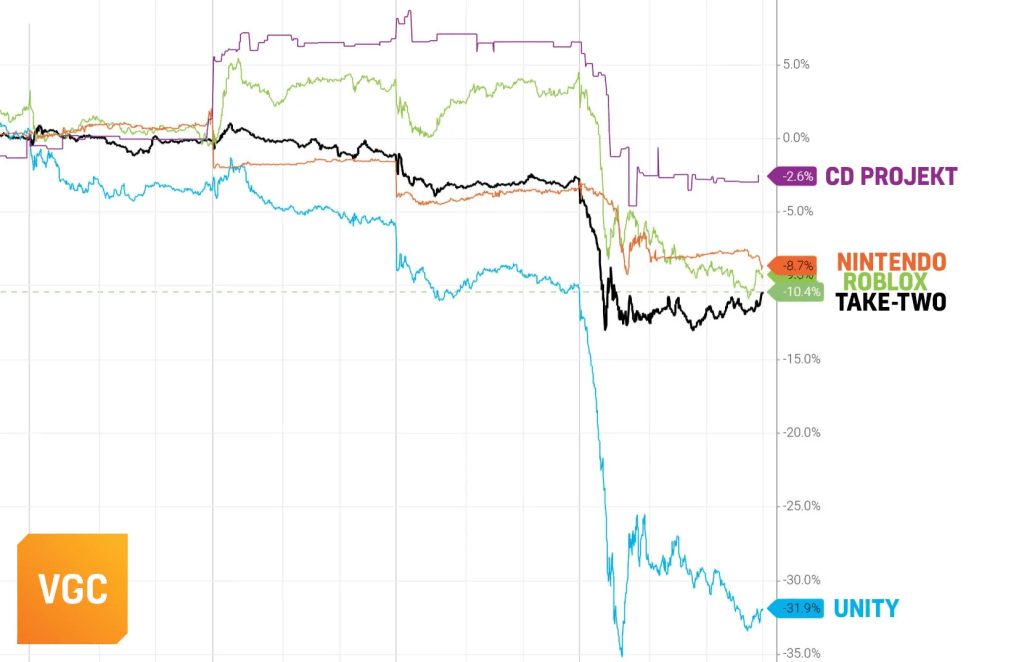
Project Genie is exciting, and I would love to add some of my own thoughts to the mix.
Is the stock market reaction rational? I think so, yes. However, there is a galaxy-sized chasm between what Project Genie can create today and what it takes to make a fun video game. Investors do not deeply understand that gap, conflating compartmentalized outputs with complete game experiences. Project Genie can create a small interactive world, but the fun inside the world is undefined.
That lack of understanding has lead to some folks thinking Project Genie will change games today. It won’t. Superficially mimicking a world is a fantastic start, but Project Genie is very far from creating fun video game experiences. There are strong parallels with how folks think LLMs are sentient because they mimic human speech patterns, or how people misunderstand LLM’s stochastic nature and over-trust the outputs.
Project Genie right now is akin to Will Smith eating spaghetti three years ago. The first AI videos demonstrated the powerful possibilities, but were clearly unrealistic. Fast forward to today, and the best we can do with AI videos is debate if they are real or AI. We can’t prove and disprove with confidence anymore, we can only have a spirited discussion on whether or not the video we are watching is actually real. That’s a pretty big leap in three years.
Project Genie is likely on a similar path, so the stock markets reacted not because video games are going away today – even if some people are saying as much – but because this technology signals a seismic change in tomorrow’s virtual world creation.
How will Project Genie change the games industry? Obviously this question requires predicting the future so take anyone’s answer with a grain of salt, including mine. I believe Project Genie will accelerate and democratize game creation, but will not replace humans in the process. This is because game creation is about two things:
- Creating a consistent world
- Being fun
I am positive Project Genie will be able to create a consistent world eventually. I am far less certain Project Genie will be able to create fun without humans. Defining fun is not something we can type into a prompt, yet we often know it when we see it. How can we expect AI to create fun when we can’t even define it to each other? Everyone in the games industry has been trying to define fun for decades, yet we still find ourselves unable to succinctly explain it. Now imagine trying to do the same, but in a prompt. It feels as tricky as asking AI to explain consciousness. Sure, it will take a stab, but it’s probably wrong.
I predict Project Genie will make it faster and easier to make games, and will enable more people to make games, however successfully creating a fun, complete experience will still require craftmanship: humans for novel ideas, play testing, and a ton of iteration – all in service of finding the fun. Project Genie will probably be great at innovating on existing designs as an accelerator, augmenting our game creation, but not replacing it.
I am excited how these tools will change our industry and enable us to drive more delightful experiences into our players’ hands. What a time to be alive!
https://blog.google/innovation-and-ai/models-and-research/google-deepmind/project-genie/
“…Genie 3 generates the path ahead in real time as you move and interact with the world. It simulates physics and interactions for dynamic worlds, while its breakthrough consistency enables the simulation of any real-world scenario…”
 Meir's Monthly Learning Article
Leave a comment